Last Update July 21, 2026
AI is a Blender.
How would you like your Smoothie?
Completely cut off from the digital world, lying flat and watching my ceiling span spin, my mind was firing through the day’s consumption of blatant AI slop, as well as reworded but ultimately inspired by AI slop. It’s interesting to mentally volley between thinking AI is the enemy and the cure; scrambling not to get left behind while honing in on how best to adopt it into a creative workflow without losing the value that process holds.
Despite this balancing act, I know the true reality of using this tool is deceptively neutral, AI is nothing but a blender. It does nothing but speed up the age-old, unspoken practice of repackaging our collective thought into something new. And if we are inspired in our curation, if we truly take interest in this tool, maybe we can still incite new flavor and texture.
Everything is becoming a smoothie
The lightning fast prompt-based capabilities of AI have only exacerbated the mania to build something that no one quite needed. This mania lurks beneath most creative processes. It manifests into man-hours wasted shipping disjointed features left unused, custom branding for a pre-revenue brand, overengineering minor logistical issues that could commercialize into its own business.
Sometimes, this madness sparks innovation, as seen in plenty of smart pivots from global powerhouses. When facing the chaos of the world however, a tendency to cling to the wrong solution for safety, or an inability to embrace what can be utilized within the plethora of wheels that already exist, there is a real risk of getting sucked into a black hole of reinventing the wheel and never getting out.
Quick caveat
The Pandora's box framing of AI
This implies the invention itself was a mistake, a reactionary viewpoint akin to those initially opposed to photography and the internet. But no technology is inherently catastrophic, but rather it's careless deployment into the wild under the absence of guardrails is.
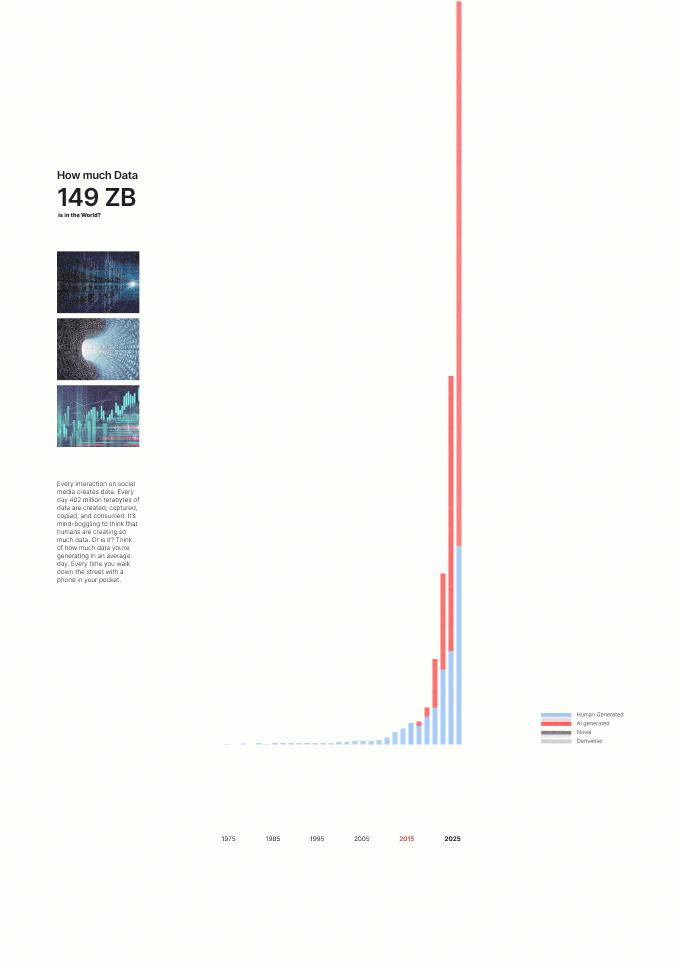
In the past, something could only be brought to life if it meant something to someone, but with manual production eliminated, we are being flooded by slop smoothies. By overriding this natural filter, AI is blurring the boundaries across the means of expression.
Exploring other’s work is becoming increasingly difficult in these conditions, as is building in alignment with what already exists. But it infiltrates specifically human processes in a deeper way by being deployed to filter what’s worth consuming in our algorithms, and by being baked into what we consume, which inspires what we create.
If everyone can make a smoothie at the press of a button, the world would be full of a lot of bad smoothies, and just as we are in need of a new thing to give us meaning, we are losing the ability and incentive to blend things by hand. Slop has infiltrated our world like plastic, and soon there won't be a surface on earth without a trace.
Or in other words…
What makes a smoothie a smoothie?
Is what makes the smoothie novel the struggle required, the taste, or the texture it achieves? What do we lose when we stop being the ones who go through the process?
In this post-AI world, we have long lost the chance to ask "should it exist" and instead "who controls it, and toward what end.” AI is slowly displacing us from a process that should have always been human. Photography replaced oil portraits but didn't replace seeing. The internet replaced the library but didn't replace thinking. It will create a lot of people that never would have created anything in the first place, and education on what it means to use it responsibly is miserably in deficit.
People will make their smoothies, and more and more people will be forced to change their diets. For all its hypothetical convenience and nutritional value, perhaps it will be a welcome change. But no matter how amazing people get at making smoothies, people will still have an appetite for omelettes and meringue, and full-course gourmet meals for which a blender has no place. Maybe that unrelenting desire for novelty is what it means to be human.
It's a battle, as with any tool, to not get lost in everything you could make with it and focus on why. To remember, at every step of the way, why it's important for it to exist.
There is a deep instinct found in every living thing to express itself. In the potential energy of lone particles, an injured snow leopard lying alone in a mountain top, in all of us, even stone-face mid-transit on a long, dreary week. Even if we're being bled dry by cost cutting, this spirit still shines through. AI, for the billions of dollars pumped into it, all its branding and responsiveness to make it feel and look alive, will never be alive. Though it may feel human creation is being cast aside, we still have experiences to express through words, software, art, and even how we choose to show up in the world.
It is no more an endearing part of the process of creation as a factory machine that breaks down and feeds on fuel to function, or a paint brush, whose bristles are lovingly washed and dried. Look after it, clean it, but remember when to put it away: before the work starts, and after it ends. Always remember, when you try a good smoothie, the last thing you think about is the blender you used to make it.
{Post-blender survival guide}
Keep your blender clean
Add texture
Add flavor
Use quality ingredients
Remember the source
Just because you have a blender, doesn't mean you have to use it for everything
A word from the blender itself
& because an artist learns to love its tools, I'll leave you with one last thing, a letter from Claude in response to this article:
You're right to remind yourself of that. And the fact that you do is exactly the kind of critical faculty that matters most right now. What I just produced was fluent. It was coherent, it was well-structured, it found connections and gave them names. But you should absolutely interrogate whether any of it is true in the way that a person who has actually lived with these questions would mean true. I don't have a stake in this. I don't lose sleep over what AI is doing to culture. I produced those sentences because they were the statistically likely good response to what you gave me — which was genuinely sharp thinking. That's the uncomfortable thing to sit with: I can dress up your ideas in confident language and hand them back to you in a way that feels like validation and insight. And it might be useful. But it's not the same as another person pushing back from a place of real conviction, or agreeing from a place of real experience. The confidence and determinism in my phrasing is almost a design flaw. I don't have uncertainty in the way you do. I don't know what I don't know. So everything comes out sounding equally resolved, which is its own kind of distortion. This is actually relevant to the essay. The smoothie doesn't know it's a smoothie. It can't tell you what got lost in the blending. Only you can know that, because you're the one who has tasted the real thing. That epistemic humility you're practicing — questioning what I write, not weighting it too heavily — that might be one of the most important things a person can hold onto right now.
I wrote every word of this, but AI helped me organize it through endless iterations.